Thursday, February 6, 2020

What's All the Fuss About Insulin Price Caps?

Insulin price capping bills have been hot news lately. For those of you that may have seen the headlines, but don't necessarily know exactly what these bills mean for diabetics, this post is for you! A breakdown of what they mean and what else we still need to help address the current problems being faced.

Most of these bills cap insulin at $100. Is that for everyone?

In brief, no. Most bills proposed so far, including the one in Colorado, only cap the copay for individuals with health insurance. Another important factor is that this law is not applicable under all forms of insurance. So, not everyone with insurance may qualify. Plans that are subject to federal regulation may be ineligible for this price cap, such as self-funded employer plans that are regulated under federal ERISA rules and the health insurance plans offered to the armed services (TRICARE), and Medicare. Individuals also cannot visit other states to qualify for capped insulin costs - if you're from Nebraska, for instance, and go to a Coloradan pharmacy, you will not be able to qualify for $100 insulin.

So...Who pays for this?

Contrary to what some have stated, no, taxpayers are not funding this cap. Unfortunately, neither are pharmaceutical companies. Insurance companies will have the cost pushed onto them. Does this mean premiums could rise for individuals? Possibly. However, it's very important to note that insurance companies do not pay full list price for insulin, either. Let's explore more on that below.

How much DO insurance companies spend on insulin when providing it to patients covered under their plans?

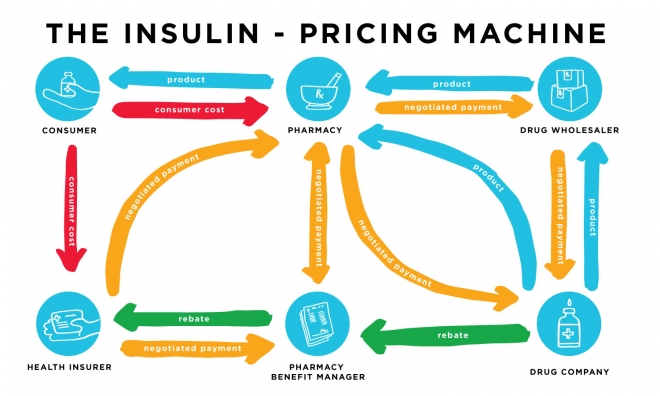
Ooh boy... this is a complicated question.  Insulin arrives at the pharmacy either directly from the pharmaceutical company, or through a prescription drug wholesaler who has obtained the drugs from the pharmaceutical company. There are negotiated payments from the wholesaler to the drug company, from the pharmacy to the wholesaler or drug company, from the insurance company to the pharmacy, from the insurance company to the PBM*, and between the pharmacy and the PBM*. Then there are the rebates the drug companies give to the PBM, and the PBM gives a portion of that rebate to the insurance company. This all changes the cost from the time the insulin leaves the manufacturer until it reaches the customer at a retail pharmacy. It means prices can vary wildly for individuals purchasing insulin, but it also means that insulin companies pay far less than list price for a vial of insulin.


What are PBM's?

* PBM = pharmacy benefits managers. Let's talk more about those, shall we? This is where the insulin pricing system gets very complicated, because there are five entities making money from the singular transaction of a customer purchasing their insulin at the pharmacy. PBM's are third party intermediaries who negotiate prices between drug companies and insurance companies. Well, they're supposed to be third party - but this line is getting very blurred. The three largest PBMs are Express Scripts, CVS Caremark and OptumRX. OptumRx is owned by United Healthcare, Cigna recently merged with Express Scripts, and CVS Health acquired Aetna. Kind of crazy, right? PBMs’ stated goal is to reduce costs from pharmaceuticals for the insurance companies while improving health outcomes for the members of the insurance plans. Insurance companies receive rebates from the pharmaceutical companies via the pharmacy benefit managers. PBM's in exchange, take a share of the profits from prescriptions that are sold to members of the insurance plans. PBM's are thus often invisible to consumers and can drive up the costs of prescriptions without consumer awareness. So, to recap, drug companies and wholesalers provide insulin to the pharmacy, and then PBM's help negotiate the sale of insulin from the pharmacy to insurance companies, who then provide it to consumers).

To obtain a preferred spot on a PBM’s formulary, drug companies are often forced to bid against their competition by offering greater and greater rebates. Drug manufacturers are then being forced to maintain or increase pricing as a hedge against discounts and rebates taken by the middlemen  (PBM's) to keep the manufacturer’s products competitive for coverage by health insurers and sale through consumer prescription drug plans. Thus, the individual without insurance, or with a high deductible plan, pays a higher list price on insulin, while the insurance company does not necessarily.

I had to take a break after writing that... it's a LOT of info. 

So who do these bills benefit?

Well, they do a lot of good, absolutely. When I was a student and the only plan my school offered was high deductible, it would have helped a lot to have prices capped at $100, because since my deductible was $4500+, I would have to pay that before my insurance helped to pay. AND... medications such as insulin do not always count towards your deductible! So even spending a crazy amount on the cash price may not do much good. So, they really help individuals with those kind of plans.

Is the total amount you spend on insulin capped at $100?

Sadly no - it's $100 or less per insulin you fill. Most diabetics still need 2 types on insulin a month. Lawmakers in Colorado are actually seeking to close that loophole and clarify the cap language, however, so this could change. 

So if you don't have insurance, you don't qualify for the $100 cap?

Yep, unfortunately that's correct. However, some bills proposed, such as one in Tennessee, would cap prices at $30 for those with health insurance and without. This would be very beneficial!

What else needs to be done?

Many lawmakers who have proposed these bills so far acknowledge that it's a temporary fix. These bills are doing incredible good and helping to ease the pricing burden on consumers, and it was a fast way to help alleviate some of the crisis that many of us who can't afford insulin face. The fact still stands that the majority of people who ration their insulin (26% of diabetics, it's estimated) are not insured, but steps are actively being taken to try to address this on a level that more places responsibility on drug companies. It's a complicated issue with the PBM's for sure... although considering the major insurance companies own the major 3 PBM's, maybe it's a lot more simple that we realize. At any rate, there's still work to be done - so don't take these bills as a sign that we can stop advocating for affordable insulin pricing any time soon.


Sunday, February 2, 2020

Update on My Life in 2020!

I've been absolutely horrible with blogging in the past year! This is an absolute shame, as so much has happened and this has been such a big year of transition for me in many aspects of my life. So instead of basing this post on something entirely diabetes related, I figured I'd try to jump back in with just a brief overview of everything that's been going on!

Last year in April, I received my very first continual glucose monitor (CGM), my Dexcom. I have to say that it has absolutely been the singular most life changing tool to help me manage my T1D. It's almost hard to explain both my simultaneous adoration for and dependence on this piece of equipment now that I've enjoyed it for over 10 months. The Dexcom is an insertable sensor that is wearable for 10 days and provides 24-7 around the clock blood sugar readings, alerts when I'm low/high, as well as an app that compiles all of my data into my A1C, blood sugar trends, and allows my doctor to easily download my readings. Honestly the best way I could describe having a Dexcom is like going through the entire day without your phone or watch and having no way to track the time except for physically looking at a clock on the wall or asking the time. It does the trick, but there's no comparison for managing things when you have the availability to access information any time you wish. And I can sleep easier knowing I'll have an alert should I ever go low.

In July, I also transitioned to an insulin pump after MANY years of pushback on my part. The Dexcom made a pump seem more palatable, seeing the ease it provided me, so I was ready to make the jump (much to my doctors delight). I'll definitely add that it was a very expensive year for health care costs for me... but would that change my decision? Not at all. Some things are just worth it, and both of these tools have been so instrumental in helping me manage my health and make diabetes a smaller part of my life. My relationship with my pump, the tubeless Omnipod, has been more a love-hate than my Dexcom. Omnipod is wearable 3 days and I do have to be careful to time things well otherwise my pump will expire during the afternoon at work. I also have to be mindful of placement for my princess parties, meaning my legs take somewhat of a beating. It's a lot easier for your blood sugar to spike if there is a malfunction since you receive little bursts of short acting insulin throughout the day, too. Randomly I've been out and my pump would just malfunction and stop working. This has happened on 3-5 occasions since I got it for reasons I and Omnipod have been unable to figure out (random occlusions), so I have gotten in the habit of always carrying a spare insulin pen with me in my purse. I find that if my blood sugar ever spikes from a pump malfunction, I almost always get sick - I don't really know why a high from a faulty pump makes me feel worse than a high back when I was on MDI's. Or, perhaps the good answer is that my sugars are far better controlled now, so I'm just not used to high levels anymore. Compounding things is the awful adhesive allergy I've developed to the Omnipod - after about 4 months, the adhesive started giving me what I have to assume is contact dermatitis that is extremely itchy, painful, and scars me. It's gotten so bad that my skin as a whole has gotten more sensitive to adhesives, even certain fabrics, that will give me a rash. And I have to use a barrier bandage on top of my pump adhesive, and even that has been wearing off in effectiveness, leaving me scrambling to constantly try out new barrier tapes and skin preps. This has been very difficult for me, but I'm trying to stick it out because I just love the convenience of a tubeless pump. If I can, my next goal is to download a closed loop system, and start combining my pump and CGM to allow an algorithm to essentially control my BG. I've heard it's a bit of a learning curve, but I'm up for the challenge.

I also switched jobs... October brought a lot of new Medicare coverage changes to nursing homes, and it was at that time that I was really itching for a change, regardless. I felt I needed to try to move on and push myself into new roles and areas in which I could learn different skills and develop myself as a clinician and person further. So with a good deal of difficulty, I made the decision to change into a new role as a director of rehabilitation with Legacy Healthcare, and I can honestly say it's been such a healthy and fulfilling change for me. My work life balance is wonderful, I've had wonderful feedback from patients, and I still have so much to learn, but I've already grown exponentially and I feel I can use a lot of my life skills from my owning and operating a business for years in my "adult" job. This ability to blend skills has made me feel a whole lot more synced into life in a whole, instead of splitting my life into two separate worlds, and I am just so thankful for that in every aspect.

There's been a lot of minutia aside from that. I've reached out to a couple of news stations and newspapers to try to advocate more for T1D, but haven't really heard back from anyone. Nonetheless, I've been so encouraged because news about the insulin pricing crisis has exploded in a big way, and people are finally starting to wake up and listen to our cries about not being able to afford this life sustaining drug. It's made me so grateful to know that we are passing laws that can prevent people like me, struggling and vulnerable young adults who are underinsured (amongst so many others), from having to resort to dangerous and difficult methods to obtain insulin - which is good also because unfortunately, there's been a lot of crackdown on "black market" insulin, making it hard to obtain it online for people who need it. I don't even know how I would manage now were I in the same position I was in 3-4 years ago. It's a scary thought, but encouraging to know I had so much support from people who helped me never have to go without it.
I've gotten into cons and cosplay in a big way, and recently gotten a sewing machine to try and start making my own costumes. I've also really delved into my enjoyment for dungeons and dragons, become a full-on anime nerd, and been consistently working out for over a year now!

Aside from that, I've also been a little quiet because I've been trying to advocate for T1D more on social media. And, I've been writing my book! It's been my goal for years to compile this blog into an actual book, and a dream of mine to write one since my diagnosis. I've really been sitting down to focus on cleaning it up now, and then (hopefully) pursuing the next steps to actually taking this goal into fruition. Any and all advice welcome!

I'll end this with saying thank you to everyone that has read this blog over the past few years, and helped with advocating for T1D awareness. It means the world to me. I'll definitely try to be a lot more consistent with blog posts this year, and I'm hoping 2020 lays a lot more groundwork for progress for health care coverage improvements and medication prices in this country.


Friday, July 12, 2019

A Farewell Letter to MDI's (Multiple Daily Injections)

Dear MDI's,

I remember the sun as it filtered through the small window of the doctor's office and onto the table. On it held an orange, a cup of water, and a few littered syringes. My mother, my dad, and my diabetes educator sat around the table. "This is how you do it," she showed us all, injecting the syringe into the orange. "The orange is similar to human skin. Porous," she said. I shed a great deal of tears before I could give the injections without cringing. I was so nervous, fixated on how much it would hurt. But my desire to live overcame my fear.

8 years of my life, so long now it seems, a needle has never been far from me. Car rides spent trying to angle myself right while driving to inject if I am in a rush in between gigs... running out of insulin in my pen on accident and searching for a spare syringe to try and draw the last few units out of the empty pen. Trying to remember to inject 15 minutes before mealtimes. Bruises and searching for new injection sites while accommodating hundreds of different types of outfits. Getting blood on white clothing, always, inevitably. Bent syringe needles. Sticking insulin in coolers when going out to avoid it getting ruined from the heat. Waking up in the middle of the night to test and inject correction doses. Trying frustratedly to avoid nighttime highs from intense workouts. Double injecting for pizza 2 hours after eating it (still a pain).

1-2 long acting injections daily. Various short acting injections - one for each meal, any snacktimes, any corrections. A minimum of 4-5 shots a day. 8 years. Over 15,000 injections in 8 years. 15,000! What inch of my skin hasn't had a needle put through it, at this point? I have always hated it - and even when I find a comfortable piece of skin to inject, I have to rotate it, to avoid lypohypertrophy (a lump under the skin caused by accumulation of extra fat at the site of many subcutaneous injections of insulin). A condition just for us diabetics.

This has been my life as I have known it, and I've gotten comfortable with it. I feel nervous embracing a new change, and I desperately hope I'll like it, and won't want to switch back. MDI's are a pain in the ass, but they're also in my comfort zone. There's a certain freedom to having nothing attached to you... and pumping is certainly expensive, even with good insurance. But I'm hoping I can get even tighter control of my A1C using one, and that it will be worth it. Truth be told, I'm very nervous! I'm nervous the pod will hurt to insert. You stick it on your skin, and then you start the sensor, and it automatically injects for you. That's silly, as I inject myself multiple times a day as is, but I'm nervous all the same. It's another thing to get used to. Another thing to plan for on trips out of town. Another thing to pack for. Another way that Diabetes is a constant presence in my life. But, that's the way it's gone for 8 years, isn't it? Learning and growing despite my illness. Pushing through, steadfastly, despite the daily pain, the extra steps, the anxiety, the blood, the bruises. This is the price of my life, and it's always been worth it, even though it's harder than before.

So, here's to a new adventure! Make it make life even better - and the space Diabetes shares with me, smaller.

Sunday, June 16, 2019

3 Years Without You.

Fathers day is always tinged with a little bit of sadness for me, as it's been 3 years since I've talked to my dad. For all of you kids out there who have a difficult relationship with a parent - I understand firsthand what that feels like, and how hard it can be. Growing up, it was always a guessing game to see if my dad would show up to gymnastics meets, graduations, birthday parties, dance recitals. Normally my father would arrive hours late, and we used to joke that we had to tell him to show up 3 hours early just to get him there on time. When he moved out of state when I was in middle school, I didn't see him for over 2 years. I remember crying back then - how much I missed daddy. Wondering when I would see him again. Feeling certain that he spent every day thinking of me and how much he missed me. But as an adult, the honest truth is that I really don't know if my father ever thought of me at all. I'm sure my father loves me, but maybe it's just not the kind of love I needed. It was only ever one sided. Hours in the car with him while he smoked, telling the same life stories. Years of forgetting birthdays. Sitting by the front door for 5 hours waiting on him to show up when he said he would. Calling to say he'd forgotten and wasn't going to make it. Or worse - the times when there were no explanations at all. My father hung the moon to me when I was a girl. I loved my mom, but she was tough on me. I was dad's little girl. He always had my back. 

The day I decided to stop talking to my father, my mother told me how she'd tried my whole life to hide the kind of person he was from me. This is the depth of a mother's love, I suppose. But on that day, the puzzle pieces of my entire life felt like they clicked into place. It was the day before my wedding, and I hadn't heard from my father, even though he'd promised he'd be there. I had put off contacting him, worried about what might happen, but wanted to put the reality off. Everyone else was in town. I wanted to preserve the happiness I felt then... to put it into a box to keep it forever. A weekend surrounded by all of the people in my life I loved most. Including my daddy. I finally reached out to him, and that's when he told me,

 "Oh, honey, sorry, I can't make it... xoxo". 

I feel so much anger about that moment even now, even 3 years after coming to peace with things. That day, it felt like cold anger. Anger that had lived within me my whole life, burning only softly in the background. How could I even be that upset, knowing without wanting to ever admit it to myself that I'd never been my father's priority? I was heartbroken. Of course I was. That was the only time I shed tears over it. But this scenario encapsulated the relationship I'd had with my father for 22 years, whether I'd wanted to see it or not. The same thing had happened for my college graduation when he cancelled the night before, citing he just needed some time to decompress from work. All I'd wanted was to see my father for my graduation. Did he even care? Did I even make him proud? The 4 years that went by that he'd promised he'd come visit me at college. All the promises my father ever made, in fact, that were only fiction. The agreement him and my mom made to help me pay for my college tuition when my loans were short what I needed. "What am I going to do, then, Dad?" I'd asked him. "Drop out?" "I honestly don't care," my dad had told me. "If you have to drop out and work at McDonald's, that's God's will!" 

This isn't really a post meant to bash my father, though. That's just to fill in a backstory for you. It's more just to reflect on what being his daughter feels like, and truly, it's this: Always having loved the idea of my father. All that I wanted him to be. All that I hoped he would be. But there may come a time in your life when you realize that your idea of who someone you love is isn't the same as reality. When, as much as you love them, you realize that the cost of continuing to let them in and let them hurt you really isn't worth holding on that long kept dream or idea. And this is why I chose to let go of my father. I tried to amend - I really did. I confronted him. I told him how he hurt me, many times. But my father never listened to me, even then, the last time. He only ever brushed what I felt off, and then ignored it like it never happened. Even now - my father will send me messages. Songs, or political opinions, or random news articles... acting like it never happened. I sent my father a long message about why I would no longer be talking to him on that day that we last spoke. He never responded. Never sent a card, or a present, for our wedding. And now he acts as though he can just nonchalantly still be a part of my life? The answer will be no, so long as my father chooses to ignore that he has hurt me in more ways to number. The answer will be no, so long as he refuses to sit down and have a conversation with me in which he holds himself responsible for his actions. And I truly doubt that day will come. It's not impossible, but nothing ever is, but... I don't hold my breath. Not anymore. He isn't worth that kind of heartache.

It's been 3 years, and things feel almost the same. My father never tried to be a part of my life. Never put the effort in. That hasn't changed. But what has changed is that my dad doesn't hurt me anymore, because I got to choose that. And that feels good. Because the cool thing about adulthood is that you do get to choose who you let in to be a part of your family, and I have a really great stepdad that I know loves me and has my back. I enjoy spending time with him. I never worry about whether he'll keep his promises. He's always 15 minutes early. He's reliable, and we butt heads sometimes, but he's everything I ever hoped my dad would be like, but never was. (And he probably won't read this because he doesn't have social media, but hey, you guys get to.)

It's been 3 years, and I've grown a lot. I've been growing all along. Learning, understanding, what it means to be a strong woman even when you feel alone. Letting that fire drive me to succeed in what I put my mind to. Pushing myself to heal despite all the wounds he created. Treasuring my mother all the more for being the strong and supportive mother she's always been, as hard as I might have liked to think she was on me when I was 16. Daddy issues... sure, I have a few. That's part of who I am, and I won't or couldn't deny that. But there's no shame in that. And there's no shame in taking the reigns of your life into your own hands, and choosing the kind of family you want to surround yourself with. There's no shame in choosing to say goodbye because that's what's better for you. And that's where I'm at: this is better for me. I don't hate my father, I never will. I forgive him today and every day. But I don't want him to be a part of my life, not anymore. He had 22 years to do that, and what he chooses to do for the rest - well, that's up to him. It's not my concern anymore. I love my dad, because heck, I wouldn't be here without him. There will always be a hole left from all of the hopes and dreams I had for him in my life. A hole left in the place all children have where they crave and need the positive affirmation and love of a parent. I am left to contend with that in other ways. But I am learning. There's no shame in that. Only new strength to be found.

My thoughts go out to all of you today, who have lost fathers. Who have difficult or estranged relationships with your fathers. All of the scenarios in between. And my heart is happy for those of you who never have to confront these burdens. 

Much Love,

Lacy

Sunday, April 7, 2019

I Finally Have a Continual Glucose Monitor! Here's Why That Makes Me Angry...

I recently had the opportunity to purchase a continual glucose monitor, and in just 5 days, it has completely changed my life. Since I was diagnosed with Type 1, I have wanted one, but back "in those days", they weren't considered reliable enough to be a regular substitute for blood glucose testing (just an adjunct), and they weren't typically covered by insurance. The definitely weren't covered by Medicaid. You can imagine how excited I was to come home last Tuesday and discover the Dexcom box on the doorstep. I excitedly ripped it open, reflecting on how much this meant to me, and how long I had had to wait for one - 8 years. 8 years almost to the day, as I realized with a laugh that my diabetes "birthday" - April 3 - had come with a present this year, just one day early. 


Here's a video of me describing my experience with my CGM after Day 1 in case you feel like watching me talk about how I still hate needles for 3 minutes

I peered at the auto injector after turning on my transmitter, suddenly terrified. I grew up with an intense fear of needles, and saying I've overcome it in my 8 years with Diabetes would honestly be a stretch. More like, I've adjusted around it. I don't cry when someone has to take blood or give me an injection now. I'm okay with blood glucose testing, but I have to do it on myself. I need to have control. I wish I were better with managing my fear, but this is the best sort of agreement I could make with myself to manage staying alive. Not too bad. But I couldn't even see how big the needle was hiding in the injector. How was injecting it going to feel? The fact that I couldn't anticipate these things made me highly anxious. People rarely ask Diabetics how they feel about all the needles. Actually, they never do. By people, I mean health care practitioners. You're just expected to do the damn thing. But heck, those things hurt sometimes. Pumps? CGM's? Syringes? Needles? Lancets. They don't feel good. Sometimes, I feel like I'm just a wuss because I still think these things hurt quite badly sometimes. Not always, but sometimes. I can't really think about it, or dwell on it, because that's really not conducive to getting on with my life and, again, doing the damn thing. But in the early days, I used to meticulously count how many times I'd have to endure pain to get through the day. Twice at mealtimes, once before bed. Two in the morning. 9. I endured pain 9 times. This isn't to garner pity for myself, it's just to say that I've spent a long time getting to the point where I don't think about it much these days. I just try to get on with my life. It works well enough.

I must have pulled up at least 3 youtube videos on people injecting the Dexcom G6 sensor for the first time. No one seemed to flinch, but heck, the first girl who did it had cystic fibrosis. Were these people just all used to it and I wasn't? I put the injector up to my abdomen... and then realized it was stuck. Crap! The sensor is surrounded by a tape that adheres to your skin. If I ripped it off now, I'd ruin the sensor, and it wouldn't stick to me. I was upset. I couldn't bring myself to press the button. Kris offered to press the button. I thought about it and then chickened out and skittered away. I called my mom, trying to get the courage to do it. Damn it! This was like injecting myself for the first time. I remember sitting in the booth at the sushi place. "I'd just do it," my mom told me. "Because if I don't, I'd die. You just have to do it." Not particularly comforting, but actually, my mom has a way of not sugar coating things that helps sometimes. I cried, but I did it, feeling very sorry for myself at the time.
30 minutes later, I finally pressed the damn button, and actually, I didn't feel a thing. I shook my head, annoyed at this fear of needles, still. Hopefully, next time it wouldn't take as long. I get to leave them on for 10 days at a time.

A CGM gives 24 hour feedback on your blood glucose, gives trends (is my sugar going up or down, and how fast?), alerts me when I'm high or low, and I can transmit the data to my phone and apple watch. It's utterly incredible, and I've never had anything like it. I immediately felt as though I'd been driving a car blind all of these years - unable to witness trends in between mealtimes, or stay on top of my blood glucose, or experience what it's like to treat a low before I'm actually low. Valuable time at work that I'd have to take out just to get a single number on a screen - unknowing if I would be high or low 30 minutes later - has now been returned to me. My quality of life is 10 times better with a CGM, and I noticed this after a single day.

And to be frank with you, this is where we get to the real meat of this post, because honestly, that makes me incredibly angry. Please be aware: this is not intended to sound like a complaint. But rather, it's a commentary on the nature of our current healthcare system. I waited 8 years for this technology that has utterly changed my life, because I couldn't afford it. 3 different kinds of insurance, and none of them covered this without a huge, thousand dollar expense on my part, plus hundreds monthly for supplies. Impossible to afford without huge sacrifices. 8 years of my life where I knew injecting 15 minutes prior to mealtime was important, but didn't personally witness the difference it makes in my blood sugar until just 5 days ago, witnessing the huge spikes and later crashes that are a consequence of waiting to inject even 5 minutes before a meal. 8 years of having to so often guess. Waiting until I'm symptomatic with a ;ow of 32 to be able to treat a hypoglycemic episode. Even now, I spent $700 on this CGM to meet my deductible, and it's still $60 a month just for my supplies for this meter. Not counting my $25 copaqy for each insulin I need. The fact of the matter is, this technology is so expensive, that it's unattainable for so many who were in my shoes. A CGM has been scientifically proven to reduce A1C levels. That's 8 years of better, tighter blood glucose control I could have had had this technology been affordable. That's 8 valuable years of me being complication free, a hugely important window of opportunity in which to care for my body, that feel almost wasted. So ladies and gentlemen, this is why I get angry when people brush off LEGITIMATE concerns on behalf of diabetics by stating that they can "just" go get insulin at walmart. When will people start realizing that this is not, cannot, be the answer? My A1C has lowered by 3 POINTS since getting new insurance this year. That is, on average, a change of more than 100 mg/dL in my average blood glucose over the span of 3 months. The difference between a future with complications and a future without. Because I can afford a long acting insulin that works great for me and a piece of technology that is a valuable tool to manage my glucose 24-7.

Diabetes is not one size fits all. We cannot brush off the concerns of others like me by stating that 50 year old insulin is the answer. This is like saying that people with depression should take MAO inhibitors - a more dangerous, older version of antidepressants with a number of side effects that have rendered them less popular over the years - versus SSRI's if they can't afford them. I cannot stress enough that affordable access to the kinds of tools and drugs I believe people  need is key. I suppose I feel so compelled to continue to state this because I cannot forget where I came from. I cannot forget what it was like to live in constant worry over my disease because I could not afford to properly manage it. And I cannot stop thinking of other individuals who have gone through and are going through this, too. Let us keep fighting until this changes.

Tuesday, April 2, 2019

8 Years: A Love Letter to Diabetes

Tomorrow will mark 8 years with Type 1 Diabetes.

Trying to wrap my head around this is as impossible as trying to believe that I had Diabetes when I was first told of my diagnosis. How I'd wished they were wrong when I first heard those words... my mind had flashed back to 7th grade. English class. I had a teacher who was Type 1. I used to hear her talk about how she had to prick her finger and feel terrified at the thought just listening. She'd given us a book to read about a girl at summer camp with Type 1, and she'd gotten made fun of at camp for asking for an apple on her tray to replace her cookie. Diabetes was a vastness of knowledge that I did not understand at the time, and there was no way that I could know that just 5 years later, I would face it myself and have to come to my own understanding. 

What a mental and physical battle this disease has been. It has given me deeper understanding in life, and the ability to extend compassion to others who feel isolated or angry, depressed or confused, about their diagnoses and individual illnesses. I have spent 8 years trying to come to peace with it, as well as learn to thrive despite the setbacks it has lent me. In 8 years, I believe I've done an admirable job. I have faced navigating a world of having no insurance, relying on faith, goodwill, and my own contrivance to survive, while not becoming bitter or closed off to the world and a life I've struggled before with thinking has been unfair to me. 

Diabetes has also hardened me. I've often thought of what exactly I mean by this... which can be a hard thing to explain to the outside. I think of myself as softer before my diagnosis. I'm quite a bit sad even still for that girl who didn't value every day... I wish I could go back. I wish I could go back. If somehow, I could get just one day from back then and relive it - I would treasure it in a way that words can't express. Just to savour one more day without finger sticks or needles, hypoglycemia or the fatigue after having repeated lows... not keeping a mini pharmacy in my purse. I had no way of knowing what this level of difficulty entails. I would choose to save anyone from that. I think of myself as having taken my healthy years for granted. I mourn for her. And then there's the line of my diagnosis that I crossed. I had to learn to grow harder. I missed the normalcy of my life, but I could only miss it as we all too often do: in retrospect. To overcome my fear of needles, to do what needs to be done. To sacrifice income, to sacrifice comfort, to sacrifice security, not even necessarily by choice - simply because of a defect in my genes. All to get on the same level playing field as many of you. To accept this as something I cannot change. I experienced a deeper understanding of what suffering meant. I experienced what it feels like to have my health, my future, and my independence come into question. I experience daily what it is like to fight harder than others without this illness around me in order to have the same opportunities. I learned to say no so that I could take time to care for myself. I learned to understand that who I was before my diagnosis and who I am now are different people. I've learned to take myself when I feel broken and beat down and glue those pieces back together. 

I've often wanted to ask God the question of why he chose me to live with a chronic illness. Chronic illness is a world of looking for positives. Adapting to pain. Lonely periods of questioning and feelings of isolation. Of wanting to draw deep into yourself. How does one move past that? 

This blog has been my answer to that. Talking about my illness has gotten me outside of myself, and helped me to take my anger and my frustration, as well as my sadness and confusion, and turn it into a platform to share with others. Something that makes me excited to talk about, and that gives me direction and inspiration to share with others.

Does that make up for the pitfalls? No... if I had one singular desire that could be met, it would be to live a life without type 1 diabetes. But for a girl that is terrified of pain and needles, who fought her way through grad school with no doctor or insurance... I've come a long way for simply wishing for what cannot be. I've learned to thrive without that comfort and security, while maintaining a sense of hope on the backburner still. The girl I was has been reshaped, slowly, through finger sticks and thousands upon thousands of injections and vein sticks. The girl I am realizes life is not a guarantee. I cherish each day. I cherish my eyesight, the feeling of warmth and soft socks on my toes, my functioning kidneys, my healthy blood pressure. I cherish my fridge full of insulin, and a job that lets me have that. I cherish the people that have helped me and the hands that have held me along the way. No, I am not that girl I used to be anymore. 

8 years, and I am stronger. I've learned so many powerful lessons, and I'm certain that so many more await me. 8 years, but a moment can bring me back to that hospital room, a nurse on each side, an injection in each arm. 2 am in the ER, coming back into consciousness, into a world I no longer knew. 
Can I live past that? I do every day. I will continue to, every day. One insulin injection at a time. Diabetes, I wish I could change you. But you are mine, as much a part of me as the rest of me. A part of me I cannot change. But a part of me I can never stop hoping to, which is as essential to my journey as living with you.


Thank you for following me on my journey these past few years. I hope that all of you continue to.

Sunday, March 24, 2019

Bogota Pt. 2

Kris and I are safely back at home now, where I'm at a much more comfortable place to blog about the remainder of our trip! I thoroughly enjoyed Bogota, although I will admit, leaving America always instills in me a sense of homesickness, as I always acutely remember everything that I love about my country when I have other places to compare it to. That certainly doesn't lessen my love for traveling, though.

Wednesday brought us some fantastic new adventures. Kris and I ventured out to Zipaquira (long ago inhabitants, the Chibcha, named the village for its abundance of salt), a small village about an hour north of Bogota known for its salt mines. Within a mountain within minutes of the village, there is an underground salt cathedral (Catedral de sal) that is quite unlike anything I've ever seen in my life, or am likely to ever see again. Driving out was an adventure in and of itself. We decided to go with a tour company because we were unsure of the likelihood of getting an Uber back to Bogota following our trip. And, the bus to Zipaquira only goes out on Saturdays. Our tire busted on the way out, but likely we were able to get the spare changed and stop for snacks at the gas station, selecting a number of different junk foods to try just for the sake of trying them. 


 Zipaquira itself is amazing. The tunnel in is coated in layer upon layer of salt crystals, and there are dozens of sculptures of crosses, angels, and Jesus carved into the salt. There is an actual cathedral there where churchgoers attend Sunday mass, a cavernous room containing a representation of one of Michelangelo's paintings in the Sistine chapel carved from marble, and larger than life crosses. It's incredibly difficult to describe, but I've included pictures here!


I fell asleep on the ride back, try as I might throughout my life to be an early riser (and always failing). When I awoke it was raining, and Kris and I decided to jump off the van at one of the stops north of our hotel last minute. The proceeding next few minutes in the pouring rain attempting to figure out the bus schedule in a foreign part of the city were somewhat stressful. Then, as the bus arrived, we realized that we would have had to buy a loadable card to get through the barrier - we hung back, unsure of what to do, when a woman pulled out her card and scanned us both in. "Muchas gracias", we told her, as she smiled and sat in the back of the bus. I was really touched by her kindness to two foreigners who clearly didn't understand the system. We hopped off at the Botanical Gardens with an hour left before close, wandering the lush landscape and labyrinths of trees, cacti, and flowers. The weather in Bogota is odd - it was 48 degrees and we could see our breath, but it was the balmiest 48 I've ever felt in my life, as the humidity was also 89%. It hardly felt cold at all, but my hair curled wildly regardless.
We were incredibly hangry, having skipped lunch in our rush to get to the botanical gardens in time, and grabbed dinner at a hole in the wall place called La Cuchinita, which boasted what the locals said was the best Ajiaco soup in Bogota. 


Our last day in Bogota, we hiked it back to Candalaria, and ate breakfast at a place near Bolivar square called La Puerta Falsa. I realized I'd ordered WAY too much food when my cafe con leche came with a piece of bread, an english muffin, and cheese, followed by the tamale I'd ordered that was the size of my head. Altogether though, all of THAT was about $6 USD. We wandered Bolivar square, paid $3 to take photos with a pair or llamas, fed the pigeons our leftover bread, and I haggled for some earrings at one of the local markets, before making it back to our hotel for checkout.

All in all, I'd still say Bogota is definitely worth seeing. I do wish I'd planned this trip with more than 3 weeks preparation, in order to better practice Spanish and lay out a better itinerary, as there was a lot of the city that we didn't have the time to see. But for a whirlwind 5 day spring break trip to South America? It was stellar, and Kris and I learned so much more about the world, new cultures, and how much we (still) adore free water.